chuangzhen@capping-machine.net

EN


chuangzhen@capping-machine.net
EN
Preform production looks straightforward from the outside. In practice, the result depends on several linked choices made before the mould ever enters the machine. Cavity layout, runner balance, cooling paths, and entry design all affect how material moves and how stable each cycle feels on the shop floor.
Some issues appear early. Others only show up after repeated runs, when small differences start to build. That is why mould design is usually judged by consistency, not by appearance alone. In PET preform mould design, the useful question is rarely whether a drawing looks complete. It is whether the structure can hold steady once production starts.
Cavity layout is one of the key points that affects how smoothly the mould behaves. When cavities sit in a balanced arrangement, flow and heat tend to stay closer to each other. When the layout feels crowded or uneven, the difference can show up in filling behavior and temperature response.
In many cases, layout decisions come down to practical checks rather than theory alone. Access for servicing matters. So does how close one cavity sits to another. Even the path from the feed point to each forming position can change the way the mould behaves over time.
A few points usually deserve attention:
A simple layout may seem easier at the start. That does not always mean it will stay easier in production.
Moving from one cavity to several changes the nature of control. A single cavity system gives more direct feedback. Once more cavities are added, variation can spread faster, and the design has less room to absorb imbalance.
This shift often affects the way the whole setup is planned. Material arrival has to stay even. Cooling cannot drift too far from one position to another. Mechanical rigidity also matters more, because the mould is now carrying more repeated load in a tighter pattern.
The usual pressure points are not difficult to name, but they are easy to underestimate:
In PET preform mould design, scaling up is rarely just a matter of adding more positions. The system has to remain readable and controllable after the change.
The runner path does more than move material from one place to another. It decides whether each cavity receives material in a steady and similar way. When the path is balanced, filling tends to stay calmer. When the path is uneven, one side may respond differently from the other.
This is where the drawing can be misleading. A runner may look symmetrical on paper, but slight differences in path length or transition shape can still affect distribution. That is why production results often reveal things the drawing does not show.
Some practical signs of a weak runner arrangement are familiar:
In pet preform mould design, runner geometry sits close to the center of the process. It shapes what each cavity receives before any local correction can happen.
| Runner condition | Typical effect in production |
|---|---|
| Balanced path lengths | More even cavity behavior |
| Uneven branching | Greater chance of variation |
| Smooth transitions | Less disturbance in flow |
| Sharp changes in direction | Higher resistance and instability |
The gate area is small, but its effect is not small. It controls how material enters the cavity and how that material settles into shape. If the entry is too abrupt, the flow can become less stable. If the transition is smoother, the cavity often fills with less disturbance.
Gate choice also influences local stress. This is often noticeable near the entry region, where material changes direction and pressure builds. A gate that works in one design may not behave the same way in another, because cavity shape and runner arrangement both matter.
A useful way to think about gate strategy is through the behavior it creates, not only through the part geometry.
| Gate behavior | What it tends to affect |
|---|---|
| Smooth entry transition | Less disturbance at the fill point |
| Sudden entry change | More local stress |
| Better directional control | More stable cavity filling |
| Poor placement | Greater variation near the gate area |
In practice, gate design is often judged by what happens after repeated cycles. The initial parts may look acceptable. A longer run usually shows a more complete picture of the process behavior.
Cooling is often where mould behavior becomes clearly noticeable. The internal shape may be fixed, but the way heat leaves the system changes how stable each cycle feels. When cooling is uneven, the same cavity can behave slightly differently over time, even if all other settings stay unchanged.
In many production cases, cooling issues do not appear immediately. The early stage can look normal. Over longer operation, small temperature differences start to influence shape retention and consistency.
Cooling channel design is usually judged in a very practical way:
The path of cooling channels is not only about speed. It is also about keeping behavior steady when conditions are not perfectly controlled.
When cavities do not stay at similar thermal conditions, the difference often shows up in subtle ways. One cavity may release parts that feel slightly different in rigidity or surface response. These variations are not always easy to notice at first, but they become clearer over time.
Temperature variation across cavities usually does not come from a single cause. It is often linked to layout, cooling balance, and even surrounding heat accumulation. Once one area starts to drift, nearby cavities may follow in a similar direction.
Typical situations include:
The key issue is not the temperature itself, but the difference between positions. In PET preform mould design, this difference often matters more than the absolute value.
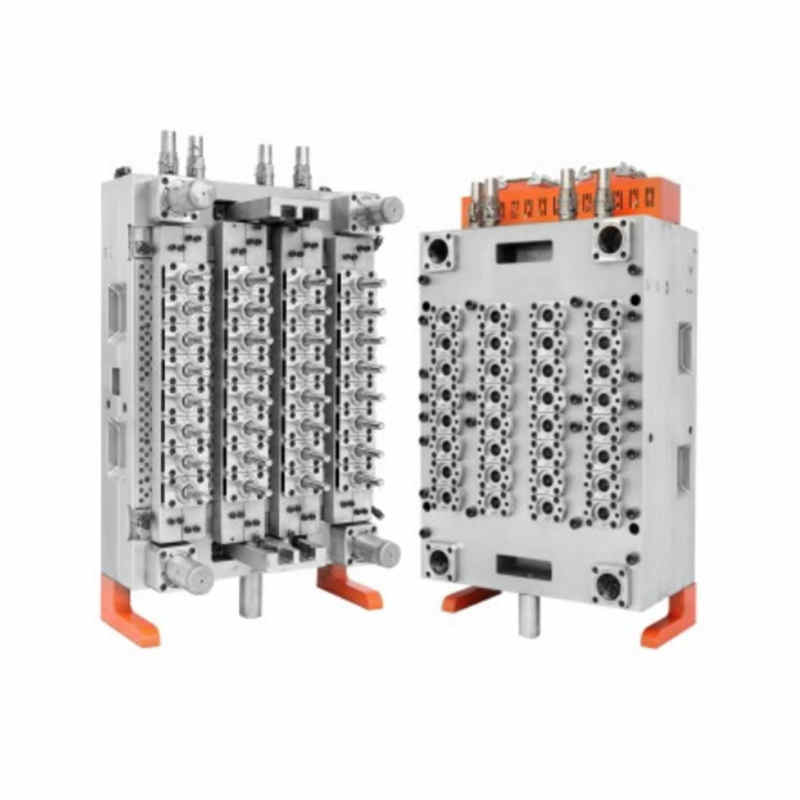
Air inside the cavity is easy to ignore during design, but it plays a clear role in how the final surface behaves. If air cannot escape smoothly, it tends to stay trapped in small areas. That can affect surface appearance and create visible marks.
Venting is not always about adding more channels. In many cases, it is about placing them where pressure naturally accumulates. When venting is too weak or poorly positioned, the material has to push against trapped air, which can disturb the surface finish.
Common effects of venting behavior include:
Venting design is often subtle. It does not always show its importance during initial setup, but it becomes clearer during stable production runs.
Structural design determines how the mould holds its shape under repeated pressure and heat cycles. Even when flow and cooling are well balanced, weak structural zones can still result in movement or slight distortion over time.
Deformation does not usually happen suddenly. It tends to build slowly, especially in areas that carry repeated load or temperature fluctuation. Once it starts, it may affect alignment between cavities or create uneven contact conditions.
| Structural aspect | Possible production influence |
|---|---|
| Wall thickness distribution | Changes in rigidity under load |
| Support placement | Stability during repeated cycles |
| Connection strength between sections | Alignment drift over time |
| Load concentration areas | Localized wear or movement |
In practice, structural design is often evaluated after the mould has already been in use for some time. The early parts may not show issues, but longer operation reveals where stress is concentrated.
The overall behavior of the mould tends to come from how each section interacts rather than from any single design choice. Small changes can shift the balance in ways that only appear during repeated operation.

Copyright © Taizhou Chuangzhen Machinery Manufacturing Co., Ltd. All Rights Reserved.

 中文简体
中文简体 русский
 Español
 عربى
عربى
